
2 maart, 2026
Did you not receive your deposit back?
Voor de Nederlandse versie , klik hier.
You are an expat and you are renting a home in The Netherlands. You have agreed to leave the rented property at a certain date. You have cleaned the property and brought it back in the condition it was when you started to rent. The landlord however refuses to give you back your deposit. What are your options?
In this article Walter Blansjaar, attorney at law specialized in tenancy law and rented housing, discusses the appropriate courses of action. Leave your contact details below and Walter Blansjaar will call you back.
What is a security deposit?
A security deposit, or “deposit” for short, is an amount that you, as a tenant, pay to the landlord when you enter into the lease. The deposit serves to make it easier for the landlord to recover damages at the end of the lease. The deposit system is regulated by law.
The deposit is regulated in article 7:261b of the Dutch Civil Code. Paragraph 1 of the article establishes the possibility to agree on a deposit. Pursuant to paragraph 2 of this article, the deposit may not exceed twice the monthly rent. This provision is a consequence of the Good Landlord Act (Article 2 paragraph 2 part c). A deposit that amounts to a higher amount than twice the monthly rent does not constitute as good landlordship. If the deposit is too high, the municipality where the property is located can impose a fine on the landlord.
Has an inspection report been made?
As far as reclaiming of the paid security deposit is concerned, one can distinguish two different situations. The situation where a report of the condition of the house at the start of the rental agreement has been drawn up and the situation in which no inspection report has been drawn up.
Option A: there is a report of the condition of the house at the start of the rental agreement (inspection report)
Was an inspection report made at the time you entered into the lease? A report of the condition at the start of the rental agreement (in Dutch: opnamestaat) is a document, usually in the form of a checklist with photos and additional notes, describing the condition of the rental property.
You must return the property in the same condition at the end of the lease. This follows from article 7:224 paragraph 2 of the Dutch Civil Code. However, you do not have to repair normal wear and tear or anything that has been destroyed or damaged due to age. If you have made changes in or to the property, and you have permission from the landlord to keep these changes, you do not have to undo these changes.
Attention: in some cases an “opnamestaat” does not qualify as an actual “opnamestaat”. This is the case, for example, if the report is so brief that from it, it cannot be determined what condition the rental property was in at the beginning of the lease. This could be because very few photos have been included or because the photos are blurry. If the report does not meet the requirements of Article 7:224, paragraph 2, the court may conclude that there is no inventory and therefore no description of the rental property. In that case, the following applies.
Option B: there is no report of the condition at the start of the rental agreement.
If no description of the condition of the rented house was made prior to entering into the lease the following applies. The tenant is assumed, subject to evidence to the contrary, to have received the rented property in the condition it is in at the end of the lease. This follows from article 7:224 paragraph 2 of the Dutch Civil Code.
It is thus up to the landlord to prove that the rented property was in a worse condition at the time at the end of the rental agreement compared to the start of the rental agreement. The landlord must prove that there is damage and what costs he had to incur to repair the damage in order to withhold (part of) the security deposit.
When must the landlord pay back the deposit?
The landlord must pay the deposit back to the tenant within fourteen days after the end of the rental agreement, unless:
- there is damage within the meaning of article 7:218 of the Dutch Civil Code, and provided that there are demonstrable costs incurred to repair that damage (sub a), or;
- there is overdue rent, “energy performance compensation” or service costs charges within the meaning of article 7:237(3) (sub b).
In the above cases, the landlord is allowed to subtract the costs from the deposit within 30 days after the end of the rental agreement. The landlord has to return the remainder of the deposit to the tenant.
If the landlord withholds a part of the deposit, under Article 261b(3) of the Dutch Civil Code, he must notify the tenant in writing and specify the repair and/or cleaning costs in full. In order words: your landlord should be able to provide you with invoices that back up the alleged repair and/or cleaning costs.
Is your landlord required to give you a reasonable time to remedy any defects? No
If the rented house has not been properly delivered at the end of the lease due to damage resulting from an attributable failure by the tenant to fulfill its obligations of delivery under the rental agreement, the tenant is in default without prior notice of default. (HR November 27, 1998, ECLI:NL:HR:1998:ZC2790). The landlord is then entitled to damages. By its nature, the obligation to deliver the property properly can only be fulfilled at the time the lease ends. This date therefore constitutes as a final deadline. The legal concept of ‘default’ (in Dutch: verzuim) therefore commences without prior notice of default. (ECLI:NL:GHAMS:2022:1257 and ECLI:NL:GHARL:2023:4516). In other words: after the lease ends, your landlord is not legally required to provide you with another opportunity to bring the property back into a state it was when you entered into the lease.
In practice, rental agreements often mention some type of end-of-lease procedure. It often follows from the rental agreement and the applicable general terms and conditions that a preliminary inspection (or pre-inspection) must take place and that the tenant must be given a reasonable time to remedy any defects or omissions found during the preliminary inspection.
The lease agreement and the general terms and conditions in practice
As already mentioned, in practice, the rental agreement and/or the general provisions often state that a preliminary inspection must take place near the end of the lease. This means that in these cases, there are a total of three moments in which the state of the rented house is assessed: 1) the inspection and report prior to the rental agreement, 2) the pre-inspection and report and 3) the final inspection and report.
Note: If you're a tenant, explicitly request a pre-inspection from your landlord so you can take action on any defects or have them repaired.
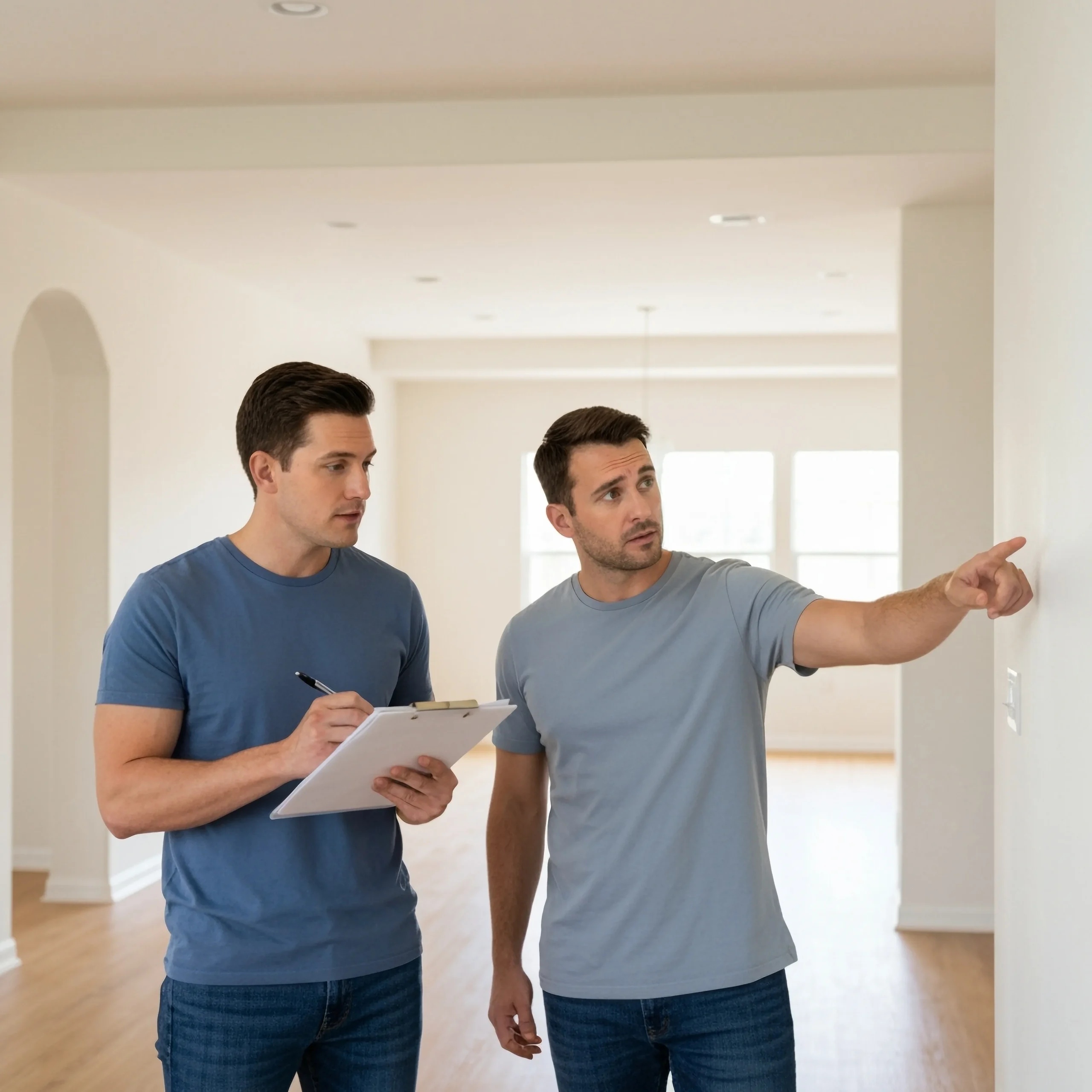
During the pre-inspection, the property will be assessed for any damage, and it will be determined if repairs are required. If repairs are needed, the landlord will prepare a report outlining the necessary work. Both parties will sign this report. If you do not agree with the pre-inspection report, do not sign the report. The pre-inspection typically occurs about two weeks before the end of your contract, giving you sufficient time to carry out any required repairs. Repairs can be made until the final day of your rental agreement.
The final inspection typically occurs a few days before your contract ends. During this inspection, the landlord will verify if all the repairs listed in the report have been completed. Additional repairs can only be requested if the landlord missed damages during the pre-inspection. You remain responsible for covering the cost of any agreed-upon damages that were not repaired.
Note: a common mistake landlords make is that the photos in the inventory differ from the photos taken during the final inspection. For example, if the inventory doesn't mention the dust-free tops of the interior doors, and no photos of the top of the interior doors are included, the landlord cannot successfully argue in the final inspection report at the end of the lease (for example, by providing a detailed photo of the dust-covered top of the interior door) that the tenant needs to clean the tops of the interior doors. The condition of the doors is in that case not reflected in the inventory.
Lawyer Dutch tenancy law and rented housing
Does your landlord refuse to give back your deposit?
Do you rent a house in The Netherlands and does your landlord not want to return the deposit? Perhaps this is unjustified. Contact Walter Blansjaar, lawyer specialized in Dutch tenancy law and rented housing, for a telephone consultation.
Heeft u vragen over dit onderwerp? Laat uw gegevens hieronder achter en we bellen u terug.

Walter Blansjaar
Als advocaat ben ik deskundig, betrokken en doelgericht. Mijn positie is duidelijk, het belang van mijn cliënt staat altijd voorop. Dat geeft mijn cliënten rust. Het is fijn om iemand te hebben die 100% aan uw zijde staat en altijd in uw belang denkt. Waar anderen obstakels zien, zie ik mogelijkheden. Middels creativiteit en het buiten de gebaande paden durven denken boek ik resultaat. Ik bijt mij vast in uw dossier en ik ben niet bang voor een ingewikkelde procedure. Zacht als het kan, hard als het moet. Mijn werkwijze kenmerkt zich door betrokkenheid en heldere, directe communicatie. Een persoonlijke aanpak met korte lijnen heeft de voorkeur. Daarbij hoort een praktische vertaling van de juridische complexiteit. Ik ben gespecialiseerd in het intellectueel eigendomsrecht (auteursrecht, merkenrecht, modellenrecht, handelsnaamrecht, domeinnaamrecht), het mediarecht (o.a. onrechtmatige perspublicaties, portretrecht), het reclamerecht en het privacyrecht. Mijn ervaringen binnen de webdevelopment, SEO, marketing en de innovatie afdeling van het RadboudUMC bieden mij de juiste handvatten om cliënten zowel binnen de innovatieve en creatieve sector als daarbuiten uitstekend bij te staan.
Email
Telefoon